

Quick answer: Scholars and bodies such as the OIC International Islamic Fiqh Academy, AAOIFI and the Fiqh Council of North America say zakat is due on shares, and the amount depends on why the shares are held. Shares bought to trade are generally treated like trade goods, so 2.5% of full market value is due on the zakat date. Shares held long term are mostly assessed on the owner’s portion of the company’s zakatable assets, though a minority approach looks only at dividends.
Why shares are zakatable at all
A share is a slice of ownership in a company. The International Islamic Fiqh Academy, in Resolution 28 (3/4) of its fourth session in Jeddah in 1988, stated that zakat on shares is an obligation upon their shareholders. The company pays on their behalf only in certain cases: if its statutes say so, if the general assembly decides it, if the law of the land requires it, or if a shareholder authorises it. When the company doesn’t pay, the duty falls on the shareholder.
The Fiqh Council of North America (FCNA) frames the question around intention. Its conclusion is that the ruling depends on the owner’s purpose: someone aiming to profit from market movements and frequent trades pays 2.5% on the share values. Someone who truly invests in companies for their profitability pays 2.5% only on the company’s cash holdings, accounts receivable and inventory.
That split between “trading” and “investing” runs through almost every modern fatwa on the subject, so it’s the one to understand first.
Nisab, the lunar year and the 2.5% rate
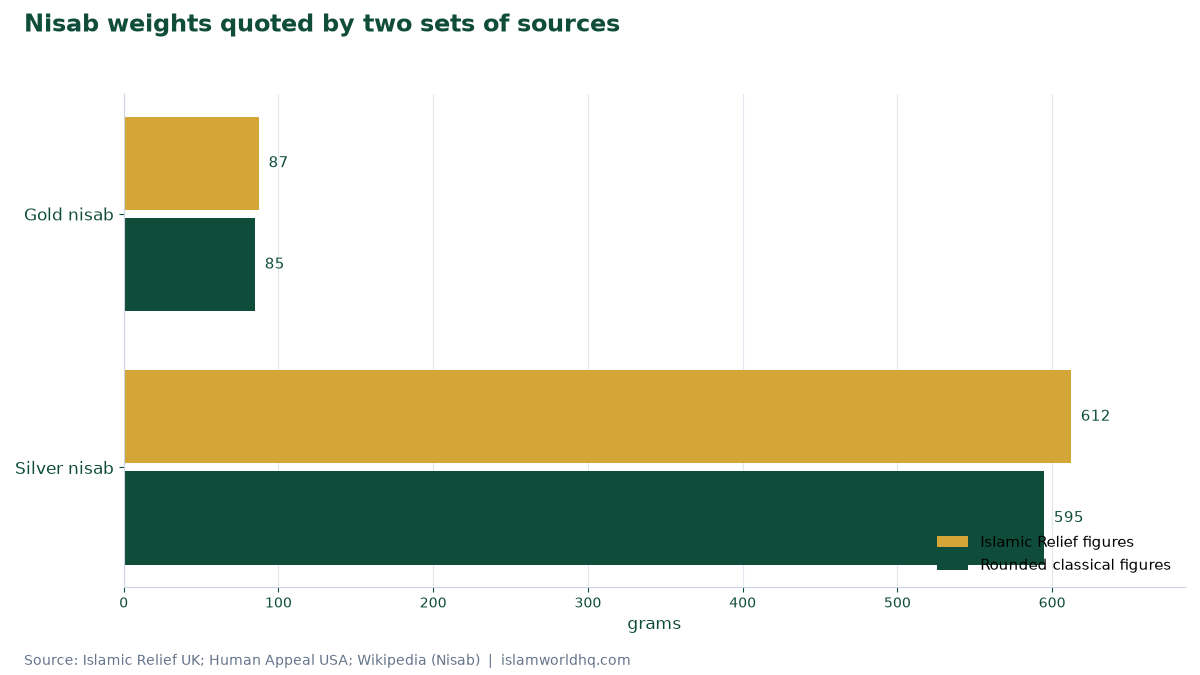
Zakat on any wealth, shares included, needs the wealth to reach the nisab (the minimum threshold) and to be held for a full lunar year. The nisab is measured in weights of metal, not in currency. It was originally set at 20 dinars or 200 dirhams, where a dinar weighs 4.25 grams and a dirham 2.975 grams.
Sources round this differently. Islamic Relief gives 87.48 grams of gold and 612.36 grams of silver, while Human Appeal gives 85 grams of gold and 595 grams of silver. The gap comes from how the old coin weights are converted, and a scholar can tell you which figure they follow.
On which metal to use, Islamic Relief notes that the Hanafi school uses the value of silver while the other schools use gold. Many scholars say the silver nisab is better because it increases the amount of charity distributed, while others say the gold nisab is closer to the one used in the Prophet’s ﷺ time. Check the current price of gold and silver on your zakat date and multiply by the weight; this article doesn’t quote prices.
Shares bought to trade
If you buy shares intending to sell them at a higher price, scholars treat them as trade goods (‘urud al-tijarah). According to the four Sunni schools, zakat is wajib (obligatory) on merchandise, paid from its price at 2.5%. Mufti Taqi Usmani is reported to hold that shares purchased for resale are fully zakatable based on their market value.
The Jordanian Dar al-Ifta, in a fatwa listed in the Shafi’i section of IslamQA, says that whoever buys shares for mudarabah (trading) is obliged to pay their zakah as items of merchandise. The shares are valued at market price, whether higher or lower than the purchase price, and 2.5% is paid at the end of each lunar year.
AAOIFI, which writes standards for Islamic financial institutions, reaches the same place. A research paper reviewing its Shari’ah Standard 35 on zakah notes that shares held for trading are zakatable current assets.
Shares held for the long term
Here the views split into two approaches, and a third sits between them.
The look-through approach
This is the most widely cited method among contemporary bodies. AAOIFI says that where shares are bought for purposes other than trading, you look at the assets of the issuing company to see what the share represents. The zakatable portion includes the company’s cash, receivables and inventory, and you pay on your proportionate share of those. Machinery, land and vehicles used in the business drop out.
Hanafi fatwas follow the same logic. One, citing Ibn ‘Abidin’s Radd al-Muhtar and Taqi Usmani’s Contemporary Fatawa, says that for a share bought to receive a dividend, zakat is paid in line with the percentage of zakatable assets within the company.
Most investors can’t read a balance sheet for every holding, so proxies exist. Muftis working for the National Zakat Foundation UK studied the balance sheets of FTSE 100 companies, found that more than two-thirds had under 25% zakatable assets, and offered 25% as a proxy. Other guides mention a quarter to a third of the share value. Treat these as practical estimates that a scholar may or may not accept for your holdings.
The dividends-only approach
The Fiqh Academy’s resolutions allow a narrower method in some cases. Where a shareholder can’t find the company’s figures and invested for annual dividends, the 1988 text says zakat is paid on the dividends at 2.5%, one year after they were actually received, and not on the market value of the shares. The Academy likened this to zakat on rented property.
A later resolution (121, 3/13, in 2001) adds detail. A shareholder who can’t tell the exact zakatable portion should make the maximum possible investigation and then pay on the portion that corresponds to his shares. Only if the company has no zakatable property does the shareholder pay on the income and not on the principal.
Investment funds and ETFs
A fund holds many securities on your behalf, so the same question applies: why do you hold it? AAOIFI’s standard, as quoted in a research paper, says zakat on investment funds in their different forms is paid on the basis of the underlying assets (the quote in that source is cut off, so the full wording isn’t reproduced here). In practice, one zakat guide says ETFs and mutual funds follow the same rules as individual stocks.
So a fund bought to sell on a price rise is usually valued at market value on the zakat date. A fund held for the long term is looked through to its holdings, which means you’d need the fund’s data, or a proxy percentage, from a qualified scholar. Funds that hold gold or cash raise the same questions as holding gold or cash directly.
The four schools side by side
The classical schools wrote about trade goods, not stock exchanges. Modern rulings on shares apply their rules by analogy, so the table shows the classical trade-goods position and what the sources used here report on shares.
| School | Trade goods (basis) | Year condition | Shares (as reported) |
|---|---|---|---|
| Hanafi | Zakatable at current market value on the zakat anniversary | Position at the start and end of the year counts, not the middle | Trading: full market value. Dividend investing: share of zakatable assets (Usmani; Ibn ‘Abidin as cited) |
| Maliki | Zakat is due on merchandise like the other schools | A hoarder (muhtakir) who sells after one year or several pays one year’s zakat | No Maliki-specific ruling on shares found in the sources used here |
| Shafi’i | Zakatable; valued at market price | Only the position at the end of the year is the criterion | Jordan Dar al-Ifta: trading shares at market value; long-term shares, add the annual profit to other zakatable assets |
| Hanbali | Zakatable at market value on the hawl anniversary | Only the position at the end of the year is the criterion | No Hanbali-specific ruling on shares found in the sources used here |
The Jordan fatwa’s long-term rule is that a shareholder who bought for annual revenue adds the annual profit to assets liable for zakat, such as cash, debts and merchandise, then pays 2.5% at the end of each lunar year. The Hanafi and the Shafi’i answers therefore end up in different places for long-term holders, and a scholar from your own school is the right person to settle it.
Worked examples
All figures below are invented, round numbers in any currency. Each assumes the total wealth is above the nisab and a full lunar year has passed.
| Example | Starting figures | Zakatable amount | Zakat at 2.5% |
|---|---|---|---|
| A. Trading shares (full market value) | Portfolio worth 20,000 on the zakat date | 20,000 | 500 |
| B. Long-term, look-through | Holding worth 10,000; company’s zakatable assets are 20% of its value | 2,000 | 50 |
| C. Long-term, dividends only | Dividends of 400 received a year ago | 400 | 10 |
Example B follows the same pattern as a published Hanafi fatwa, where a ratio of 20% zakatable assets on shares worth 10,000 gives 2,000 as the zakatable part and a zakat of 50.
The three results differ a lot, which is why the purpose of the purchase matters. Mixed portfolios are handled holding by holding: the trading part at market value, the long-term part by the method your scholar accepts. Then the total is combined with your other zakatable assets and compared with the nisab. Those assets include cash, gold, silver, business inventory and investments, and debts due are subtracted.
Using the calculator and asking a scholar
The zakat calculator on this site can help you total your assets once you know which method applies to each holding. Fix one zakat date each year and value your shares as of that date.
Questions this article leaves open include employer share schemes, shares in companies that pay zakat themselves, and holdings that came with debt. A qualified scholar who knows your circumstances can answer those.
Sources
- International Islamic Fiqh Academy: Zakah on Company Shares (Resolution 28, 3/4)
- International Islamic Fiqh Academy: Zakah on Shares Owned to Earn their Income (Resolution 121, 3/13)
- Journal of King Abdulaziz University: Islamic Economics, Zakah on Stocks: Some Unsettled Issues
- Fiqh Council of North America: Zakah on Stocks
- SciTePress: A Review of Zakat Practices of Islamic Financial Institutions (discussing AAOIFI Shari’ah Standard 35)
- IslamQA (Jordan Dar al-Ifta): Zakah of Shares is Based on their Kind
- IslamQA (Hanafi): Zakat on share price
- IslamQA (Hanafi): Rulings Related to Zakat on Shares
- SeekersGuidance: How Is Zakat Calculated on Long-Term Investments?
- Traders Union: How to Calculate and Pay Zakat on Stocks and Shares
- Al-Islam.org: The Five Schools of Islamic Law, Zakat (Muhammad Jawad Mughniyya)
- ResearchGate: Zakat Perdagangan bagi Muhtakir Menurut Perspektif Mazhab Maliki
- Islamic Finance Calculator: Hanafi Zakat Rules
- Islamic Finance Calculator: Hanbali Zakat Rules
- Islamic Relief UK: Nisab value
- Islamic Relief: What is Nisab
- Human Appeal USA: What Is Zakat al-Mal?
- Wikipedia: Nisab
- CalcaTools: Gold and Silver Nisab Explained
- HalalWallet: Zakat on Stocks
- Zakat Plus: Zakat on Modern Wealth
This article explains what the four Sunni schools say and links its sources. It is education, not a fatwa and not financial advice. For your own situation, ask a qualified scholar.